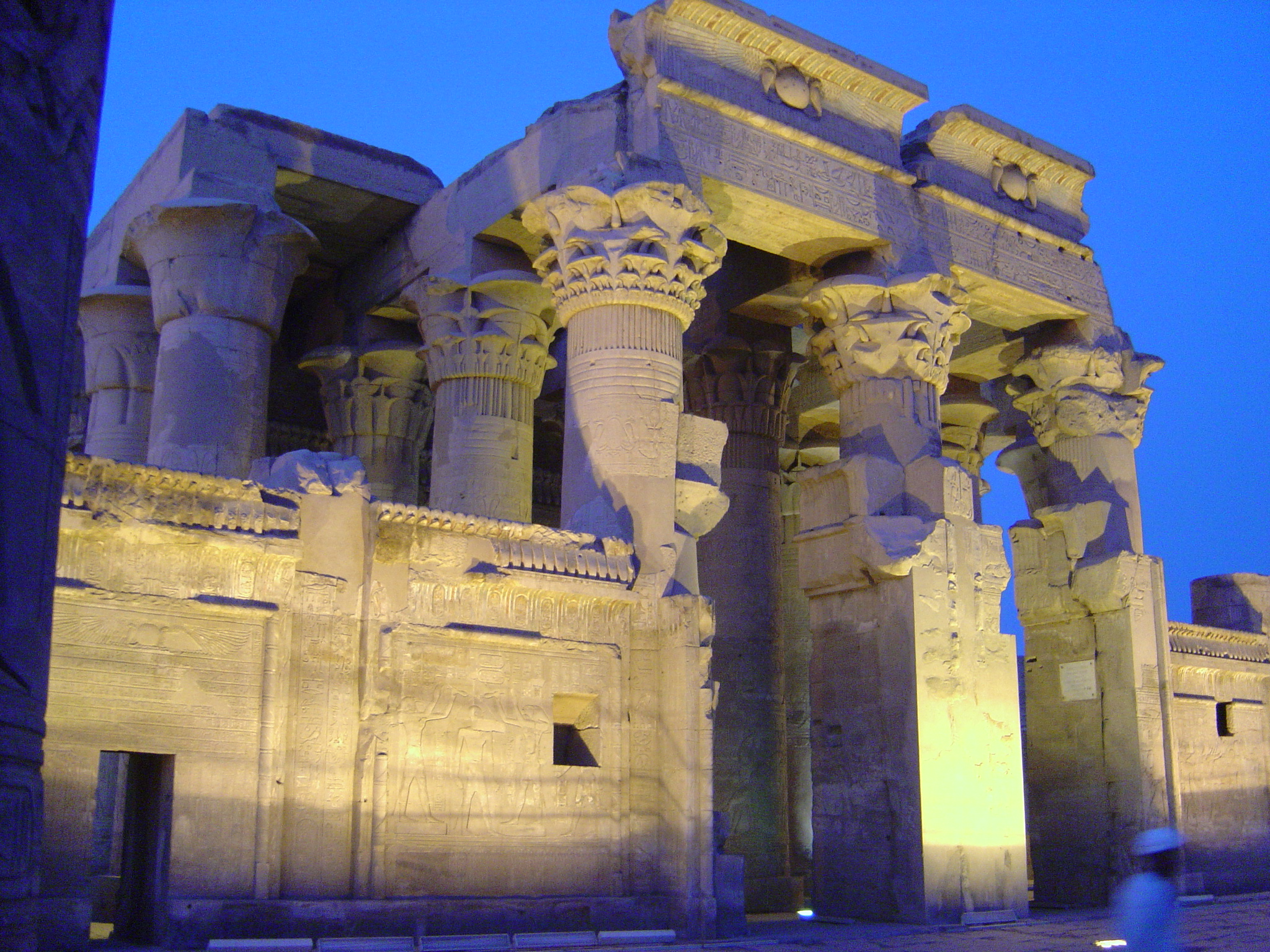
The temple at Kom Ombo
Neil MacKichan immerses himself in the world of the pharaohs on a trip down the Nile
There is a strange feeling of timelessness about Egypt. Whatever your vantage point whether you are standing on the banks of the Nile, seated on a camel, or even standing in the shadow of the Sphinx, you feel that almost nothing has changed for the past 6,000 years.
The pharaohs, and their slaves and craftsmen who built the pyramids, would have seen the same sights and even heard the same sounds as we do today — from the babble of the street hawkers to the barking of the dogs, the braying of the camels and the shouts of the fishermen.
Nowadays, beyond the ancient monuments is the occasional glimpse of a modern hotel on the skyline and yes, the pharaohs’ chariots have been replaced by tourist coaches, but basically, Egypt remains glued to its past. The Nile is the one constant; it was there before the old civilisation began, and it will still be there even when the present one has been forgotten.
Nowhere is this more striking than when you take a cruise from Luxor to the Aswan Dam. Not only is there the densest concentration of temples, but from my sun-lounger on the deck of my ship I saw the scenery change from lush vegetation to scorched rock. I wondered at the roofless, brick dwellings and imagined how similar they were to the mud huts lived in by the ancient Egyptians, who only believed in creating solid structures for the afterlife. The major difference with the modern dwellings is that most have a satellite dish.
Nothing could have prepared me for the wonders of this ancient world
The popularity of Nile cruises has meant that, during high season, the river resembles the M1 on a Friday night — nose-to-tail boats trying to moor up against each other. But whatever the inconvenience, nothing could have prepared me for the wonders of this ancient world — or the heat which can top 50 degrees during the summer.
[fancy_images width=”185″ height=”140″]
[image title =”Colossi of Memnon” caption=”Colossi of Memnon”]http://www.retiremove.co.uk/wp-content/uploads/2013/04/Collosi-of-Memnon.jpg[/image]
[image title =”Temple of Queen Hatshepsut” caption=”Temple of Queen Hatshepsut”]http://www.retiremove.co.uk/wp-content/uploads/2013/04/hatchepsu1t.jpg[/image]
[image title =”Paintings on a temple wall” caption=”Paintings on a temple wal”]http://www.retiremove.co.uk/wp-content/uploads/2013/04/hiero.jpg[/image]
[image title =”Edfu” caption=”Edfu”]http://www.retiremove.co.uk/wp-content/uploads/2013/04/Recoverd_jpg_file20161_6.jpg[/image]
[image title =”Kom Ombo” caption=”Kom Ombo”]http://www.retiremove.co.uk/wp-content/uploads/2013/04/Recoverd_jpg_file20178_3.jpg[/image]
[image title =”A view of the Nile from the Cataract hotel” caption=”A view of the Nile from the Cataract hotel”]http://www.retiremove.co.uk/wp-content/uploads/2013/04/Recoverd_jpg_file20206_2.jpg[/image]
[/fancy_images]
Our first stop was the massive Colossi of Memnon on Luxor’s west bank. These gigantic statues guarded an ancient temple, but now stand alone at the entrance to the Valley of the Kings, home to the tombs of the pharaohs.
And so my journey into a fascinating world of colourful hieroglyphics, decorations, reliefs and hollowed-out chambers began. The tomb of the best-known of the pharaohs, boy King Tutankhamun attracts the most visitors but is really not worth the extra money it costs to get in. All that remains is a replica of the king’s gold coffin and his mummy inside.
My next stop was to the temple of Queen Hatshepsut. She ruled for 15 years and died in 1458BC, leaving behind more monuments and artworks than any Egyptian queen after her.
Then came the temple of Edfu, which for 2,000 years lay covered in rubble and sand until it was cleared in 1860. Hugely dramatic, it took two centuries to finish and is dedicated to Horus, the sky god.
At Aswan, we spent cocktail hour at a more modern Egyptian monument — the old Cataract Hotel, overlooking the Nile. This was where Agatha Christie wrote Death On The Nile and where Howard Carter revealed he had found the tomb of Tutankhamun. I can see why they liked this stunning spot. From the hotel’s terrace you can watch the feluccas wind down the river at sunset.
One of the more unusual temples is that of Kom-Ombo, 28 miles north of Aswan, which dates back to the second century BC, and also overlooks the Nile. Kom-Ombo is actually two temples. The first was built to Sobek, the crocodile god. The Egyptians thought that if they worshiped Sobek, he might do them a favour and rid the area of the crocs. When that didn’t work, a second temple was erected next door to Horus. In fact, it wasn’t until the new Aswan Dam was built in 1970 that the crocodiles ceased to be a nuisance and died out.
Luxor is built on the site of ancient Thebes, the seat of Egyptian power from 2,100 to 750BC, and home to the most awesome temples in the world. Karnak, two miles north of Luxor, is the biggest temple on earth, containing 134 monumental columns, including Queen Hatshepsut’s 97-foot obelisk. The complex took more than 1,300 years to complete and words cannot convey its overpowering grandeur.
But to experience and enjoy Egypt properly, it is important to have an evenly paced itinerary which reflects the country’s exotic ancient past, vibrant river culture and modern city life. You can wonder at the biblical landscape and national treasures, but most of all it is about cutting it in the heat and dust — just like the pharaohs did 6,000 years ago.
Discover Egypt is offering seven-night Nile Cruises from £699 per person (based on two sharing a cabin). Price includes full board on the cruise, flights to Luxor from Heathrow, (Manchester costs extra), sightseeing programme, transfers in resort and all UK airport taxes. Standard booking conditions apply. Travel insurance not included. Visit www.discoveregypt.co.uk
[fancy_images width=”185″ height=”140″]
[image title=”Sunset over the Nile” caption=”Sunset over the Nile”]http://www.retiremove.co.uk/wp-content/uploads/2013/04/Recoverd_jpg_file20151_7.jpg[/image]
[image title=”Nile traders” caption=”Nile traders”]http://www.retiremove.co.uk/wp-content/uploads/2013/04/nile-traders.jpg[/image]
[image title=”Entrance to Karnak” caption=”Entrance to Karnak”]http://www.retiremove.co.uk/wp-content/uploads/2013/04/Recoverd_jpg_file20213_5.jpg[/image]
[image title=”Karnak” caption=”Karnak”]http://www.retiremove.co.uk/wp-content/uploads/2013/04/Recoverd_jpg_file20226.jpg[/image]
[image title=”Hieroglyphics at Karnak” caption=”Hieroglyphics at Karnak”]http://www.retiremove.co.uk/wp-content/uploads/2013/04/Recoverd_jpg_file20217_8.jpg[/image]
[image title=”The temple at Philae” caption=”The temple at Philae”]http://www.retiremove.co.uk/wp-content/uploads/2013/04/Recoverd_jpg_file20194_1.jpg[/image]
[/fancy_images]